


Why 90% of Regulatory Affairs Applicants Get Zero Job Offers (And How to Be the 10%)
Most regulatory affairs applicants never get an interview. Learn why — and the specific CV, experience and training fixes that put you in the top 10%.
The overwhelming majority of regulatory affairs job applications fail before a human ever reads the covering letter. This article explains what happens to those applications, who typically gets rejected, why relevant scientific and clinical experience is routinely overlooked, and what separates the small minority of candidates who convert applications into interviews and offers. It draws on the Regulatory Affairs Professionals Society (RAPS) 2024 Global Compensation and Scope of Practice Report, UK sector data from the Association of the British Pharmaceutical Industry (ABPI) and Prospects.ac.uk, and industry workforce research, alongside conversion data from Entry to Regulatory's own applicant cohort.

1. At a Glance
At a Glance
- Regulatory affairs roles are growing across the pharmaceutical and medical device sectors, yet most applicants without direct regulatory experience are screened out at the first stage.
- The Regulatory Affairs Professionals Society (RAPS) 2024 Global Compensation and Scope of Practice Report found that respondents average 17 years of professional experience, with 9 years specifically in regulatory roles — evidence of how experience-weighted this profession is.
- 65.4% of regulatory professionals surveyed by RAPS hold postgraduate degrees, mostly in life or natural sciences, showing that academic qualifications alone are the entry ticket, not the differentiator.
- The Association of the British Pharmaceutical Industry (ABPI) confirms a life sciences degree is essential for UK regulatory affairs roles, but notes employers commonly expect previous pharmaceutical experience on top of it.
- Regulatory Affairs Certification (RAC) holders earn measurably more than non-certified peers at the same job title, according to RAPS.
- Entry to Regulatory's own applicant tracking shows a 0.25% success rate for candidates applying to regulatory roles with no regulatory experience, rising to 10% with some regulatory experience, and candidates who complete 3 months of structured regulatory work experience are 40 times more likely to be hired.
- The gap is rarely about ability. It is almost always about how relevant experience is translated into regulatory language on a CV and in interviews.
Background: Why the Regulatory Affairs Hiring Gap Exists Now
Regulatory affairs sits at the intersection of science, law and commercial strategy, overseeing the compliance of medicines and medical devices from early development through to post-approval lifecycle management. Demand for the function has grown steadily as global drug and device pipelines expand, and as companies navigate increasingly complex multi-region requirements across the US Food and Drug Administration (FDA), the European Medicines Agency (EMA), the Medicines and Healthcare products Regulatory Agency (MHRA) and other national authorities. According to workforce research cited by AMS (a global talent solutions provider), the US life sciences sector faces a projected need for 3.4 million employees by 2025, with 80% of pharmaceutical companies reporting a skills mismatch in their current workforce — a finding reported in a single industry source and not yet independently corroborated, so it should be treated as directional rather than definitive. What is well documented, however, is that demand for regulatory expertise is rising faster than the supply of candidates who can demonstrate it convincingly on paper.
Interested in building a career in regulatory affairs and learning how to present your scientific, clinical or pharmacy background in language that regulatory recruiters actually recognise? The Introduction to Regulatory Affairs Course at Entry to Regulatory covers marketing authorisation applications (MAAs), the Common Technical Document (CTD) structure, EU variation classification, regulatory strategy and CV positioning, giving you the practical knowledge, real work experience and job search support to break into or advance within regulatory affairs. - 50+ CPD-accredited hours of expert-led training - Up to 3 months of real regulatory work experience - Mentoring and job search support until you are employed - Covers EU, UK and US pharmaceutical regulations - Taught by a regulatory affairs expert with 10+ years at MHRA, GSK, MSD and Bayer - Study online, part-time, just 6 hours per week View the course and start with a free introductory webinar: https://pages.entrytoregulatory.com/courses/
This gap between rising demand and applicant success did not appear overnight. Historically, regulatory affairs was a function that professionals moved into laterally — from clinical research, quality assurance, pharmacy or manufacturing — after years of adjacent industry experience, which is reflected in the RAPS finding that the average regulatory professional has 17 years of total professional experience. As the function has matured into a recognised career path in its own right, more graduates and career changers are applying directly, often without realising that recruiters are still screening CVs against the same experience-heavy expectations built up over decades.
Prospects.ac.uk, the UK's official graduate careers service, confirms that regulatory affairs officer salaries range from £30,000 to £160,000 depending on experience, and that a life sciences, pharmacy or engineering degree is the baseline requirement — but the same profile notes that "relevant experience is beneficial," without specifying how applicants without a regulatory job title are supposed to obtain it. Understanding how to bridge this documented experience expectation is a core component of the Entry to Regulatory regulatory affairs training programme, which covers CV positioning and structured work experience as part of its practical curriculum for EU, UK and US regulations — see the full course details at https://pages.entrytoregulatory.com/courses/
What Regulatory Recruiters Actually Screen For
Regulatory recruiters and hiring managers are not evaluating scientific ability in isolation — they are screening for evidence that a candidate can operate inside a compliance-driven, document-heavy process under regulatory scrutiny. This shows up in three consistent signals on a CV and in early-stage screening:
1. Named regulatory documents and processes. Recruiters look for direct or adjacent familiarity with instruments such as the Common Technical Document (CTD), electronic Common Technical Document (eCTD), marketing authorisation applications (MAAs), New Drug Applications (NDAs) and Biologics License Applications (BLAs) — not generic "regulatory knowledge."
2. Classification and lifecycle language. Terms like Type IA, Type IB and Type II variations, post-approval changes and regulatory strategy signal that a candidate understands how a product moves through its lifecycle, not just how it was developed.
3. Certification and formal training. RAPS reports that holders of the Regulatory Affairs Certification (RAC) earn measurably more than uncertified peers at equivalent titles — a signal that structured, recognised credentials carry real weight with employers, even at entry level.
> "A significant majority of respondents hold postgraduate degrees, primarily in life or natural sciences... certification, such as the Regulatory Affairs Certification (RAC), positively impacts salary."
> — RAPS 2024 Global Compensation and Scope of Practice Report for the Regulatory Profession
Candidates from pharmacy, clinical, quality assurance, chemistry, manufacturing science and biomedical backgrounds already hold much of the underlying scientific and process knowledge recruiters are screening for. The problem is rarely capability — it is that CVs describe experience in clinical, academic or manufacturing terms rather than in the regulatory terms a screener or applicant tracking system is scanning for.

The Experience Paradox: Why Qualified Candidates Get Rejected
The central paradox in regulatory affairs hiring is well known within the profession: nearly every entry-level posting requests "regulatory experience," yet there is no obvious route to gain that experience without already holding a regulatory role. ABPI confirms that a degree in life sciences is essential for UK regulatory affairs roles and notes that a medicine typically takes 10 to 12 years to move from laboratory to market, requiring sustained familiarity with evolving legislation — reinforcing why employers default to hiring people who have already worked inside that process.
Key Question | Previous Situation | What Changes Now |
Do I need direct RA experience to get an interview? | Most job postings listed "1-3 years RA experience" as a hard requirement, screening out first-time applicants | Structured work experience placements (e.g. supervised MAA/CTD assignments) are increasingly accepted as equivalent by employers assessing practical competence |
Is my clinical/pharmacy background relevant? | Clinical and pharmacy CVs were often screened out for lacking "regulatory" keywords | Recruiters increasingly recognise clinical pharmacology, drug safety and formulation science as directly transferable when framed in regulatory language |
Does a certificate actually help without a job title? | Self-taught or MOOC-style certificates were seen as low-signal by hiring managers | Employer-recognised certificates combined with documented work experience and CV evidence carry materially more weight |
Why do I get rejected after multiple interviews? | Candidates could discuss regulatory theory but had no example submissions or case studies to reference | Candidates with a portfolio of real or simulated regulatory work (variations, CTD sections, strategy documents) can answer competency-based questions concretely |
Is regulatory affairs actually hiring right now? | Perception that the sector was slow-moving or saturated | Life sciences workforce research points to a growing skills mismatch, with 80% of pharmaceutical companies reporting gaps between required and available skills |
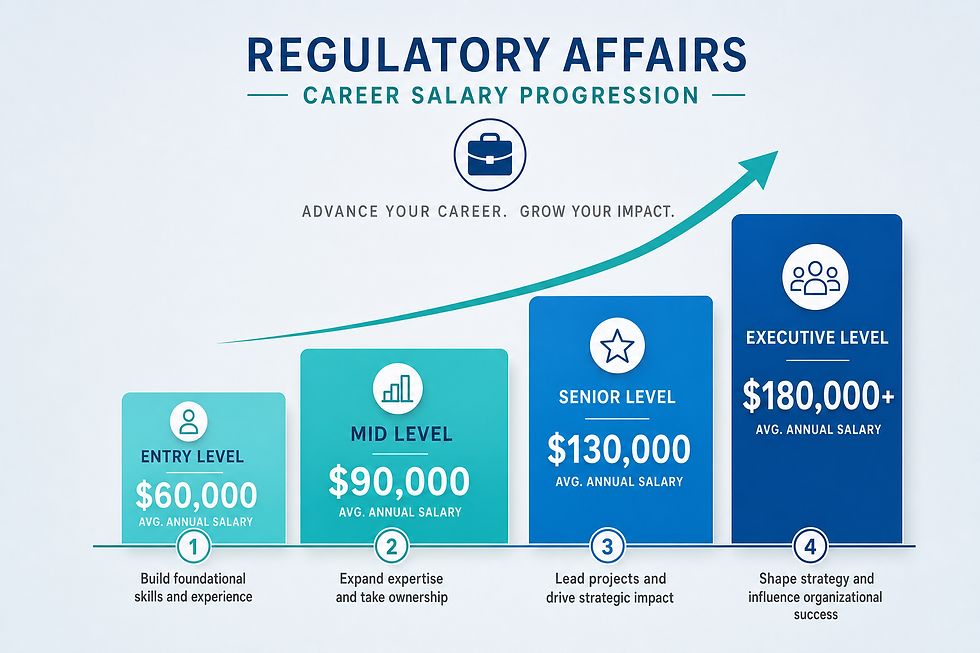
What salary should I expect starting out? | Entry-level pay was often assumed to be low across the board | Prospects.ac.uk confirms UK regulatory affairs salaries range from £30,000 at entry level to £160,000+ in senior roles, with RAPS data showing senior specialists averaging $114,963 and VPs averaging $293,251 in total compensation |
How long does a successful transition typically take? | Career changers often expected an immediate switch and became discouraged after early rejections | Entry to Regulatory's own cohort data shows successful transitions typically take 2 weeks to 9 months, depending on background and effort |
Regulatory professionals looking to deepen their understanding of how to translate clinical, scientific or manufacturing experience into regulatory-recognised evidence will find relevant practical training in the Entry to Regulatory course, which includes hands-on assignments covering MAA structure, EU variation classification and CV/interview positioning as part of its EU, UK and US regulatory curriculum. Full details at https://pages.entrytoregulatory.com/courses/
What the 10% Do Differently
Candidates who consistently convert applications into interviews share a small set of concrete habits, none of which depend on already holding a regulatory job title:
- They translate existing experience into regulatory vocabulary (e.g. describing clinical drug safety monitoring in terms recognisable to a pharmacovigilance or regulatory strategy screener).
- They can point to specific, documented work, whether from a prior role, a structured placement or a supervised training assignment, rather than describing regulatory affairs only in theoretical terms.
- They hold a recognised, employer-acknowledged certificate, which RAPS data shows correlates with higher compensation and stronger credibility at screening stage.
- They prepare for interviews using real submission scenarios — a variation classification exercise, a CTD module summary, a mock regulatory strategy memo — rather than generic behavioural answers.
- They apply with a clear regional focus (EU, UK, US or global), since regulatory frameworks are not interchangeable and recruiters test for this distinction directly.
Deepen Your Knowledge: Regulatory Affairs Training on This Topic
Breaking into regulatory affairs rewards a specific combination of knowledge and demonstrable experience: understanding of the drug development lifecycle, familiarity with marketing authorisation and variation processes, and the ability to talk fluently about submissions in the correct regulatory language for the target market. Academic qualifications establish credibility, but employers consistently look beyond the degree for evidence of applied, documented regulatory work — which is precisely the gap most rejected applicants have never had the chance to close.
The Entry to Regulatory curriculum directly addresses these areas. Its Introduction to Regulatory Affairs Course combines structured teaching on marketing authorisation applications, EU/UK/US variation classification, and regulatory strategy with up to three months of real regulatory work experience, giving candidates concrete submissions and case studies to reference in interviews rather than theoretical knowledge alone. This is paired with CV review and mock interviews, addressing the translation problem directly rather than assuming candidates will work it out independently.
This training is most relevant for life science graduates seeking their first regulatory role, pharmacy and healthcare professionals looking to move from clinical or community settings into industry, and scientists, QA/QC and manufacturing professionals who already hold adjacent technical expertise but have never had it recognised as regulatory experience. Career changers form a substantial share of this pathway — Entry to Regulatory's own data shows career changers make up a significant proportion of enrolled students, most starting with no prior regulatory affairs experience.
TRAINING SPOTLIGHT BOX: Course: Introduction to Regulatory Affairs Course Provider: Entry to Regulatory Relevant to this topic: CV and application positioning, marketing authorisation applications (MAA) and CTD structure, EU variation classification, regulatory strategy, interview preparation for regulatory roles Format: Online, part-time | 6 hours per week | 3 months Includes: Up to 3 months real work experience, job mentoring, CV review, mock interviews, industry-recognised certificate Suitable for: Life science graduates, pharmacy professionals, career changers, scientists seeking regulatory transition Start here: https://pages.entrytoregulatory.com/courses/
Practical Implications for Regulatory Affairs Professionals
The data above points to a consistent pattern: rejection is rarely a verdict on ability, but on how experience is presented and evidenced. The table below sets out the questions most relevant to applicants navigating this gap directly.
Key Question | Previous Situation | What Changes Now |
Should I keep applying with the same CV that keeps getting rejected? | Repeated applications with unchanged, non-regulatory-framed CVs produced no interviews | Reworking CV language around regulatory terminology and evidencing applied work materially changes screening outcomes |
Is my science degree enough on its own? | Degree-only applicants were routinely passed over for candidates with any regulatory exposure | A degree remains the baseline requirement, but must be paired with demonstrable regulatory-relevant work to progress |
Will unpaid or self-directed study help? | General online courses without practical components carried limited weight with recruiters | Courses that include supervised work experience and employer-recognised certification carry materially more weight |
Do I need to specialise immediately (e.g. medical devices, CMC)? | Applicants often applied broadly without a clear regional or product focus | Employers respond better to candidates who can speak specifically to one region (EU/UK/US) or product area at entry level |
How do I answer competency-based interview questions with no job title experience? | Candidates without a regulatory job title struggled to answer scenario-based interview questions | Candidates with structured training assignments can reference specific, concrete examples (a variation classification, a CTD section) |
Key Takeaways
1. Translate your existing experience into regulatory vocabulary before you submit another application — clinical, scientific or QA experience should be described in terms of compliance, safety and submissions, not just clinical or lab outcomes.
2. Pursue a certificate with a recognised employer track record, not a generic online course, since RAPS data links formal certification with measurably higher compensation and credibility.
3. Seek structured, documented work experience rather than relying on theoretical study alone — concrete examples are what interviewers actually test for.
4. Pick a regional focus (EU, UK, US, or a specific product category) before applying broadly, since regulatory frameworks are not interchangeable and generalist applications are easier to screen out.
5. Prepare for competency-based interviews with real scenarios — practise walking through a variation classification, an MAA structure, or a regulatory strategy decision, not just your CV bullet points.
6. Track your applications and success rate honestly — if you are applying broadly with no regulatory-specific evidence and receiving no interviews, the fix is very unlikely to be "apply more"; it is almost always "apply differently."
7. Attend structured career guidance early, such as a free introductory webinar, before investing significant time in unfocused applications.
Take the Next Step in Your Regulatory Affairs Career
If you recognise yourself in the applicants described above — qualified, experienced in an adjacent field, and consistently unable to convert applications into interviews — the issue is very unlikely to be your background. Understanding how frameworks like marketing authorisation applications, variation classification and regulatory strategy work, and being able to demonstrate that understanding through documented experience, is a core skill for regulatory affairs professionals at every level, from first-time applicants to senior specialists.
The Introduction to Regulatory Affairs Course from Entry to Regulatory is one route to closing that gap, combining structured training, real regulatory work experience and CV/interview support. If you are not ready to commit, the free introductory webinar is a low-commitment way to see whether this path is right for you, whatever stage of your regulatory career you are at.
Explore the full course details and register for a free introductory webinar at Entry to Regulatory: https://pages.entrytoregulatory.com/courses/

Frequently Asked Questions
### Why do so many regulatory affairs applications get no response?
Most applications are screened by recruiters or applicant tracking systems looking for specific regulatory terminology and evidence of applied regulatory work, not general scientific or clinical language. Candidates who describe their background in non-regulatory terms are frequently filtered out before a human reviewer sees the CV, regardless of underlying ability.
### Is a life sciences degree enough to get a regulatory affairs job?
A relevant degree is typically the minimum requirement, confirmed by both ABPI and Prospects.ac.uk for UK roles, but it is rarely sufficient on its own. Employers consistently look for evidence of applied regulatory knowledge or experience alongside the qualification.
### Can I get regulatory affairs experience without already having a regulatory job?
Yes. Structured training programmes that include supervised work experience placements — such as classifying variations, drafting CTD sections or building regulatory strategy documents — give candidates concrete, documented experience to reference, even before their first regulatory job title.
### How is regulatory affairs training different from a general online course?
Programmes such as the Entry to Regulatory Introduction to Regulatory Affairs Course combine formal teaching with real regulatory work experience, CV review and job search mentoring, rather than theory alone — addressing the specific gap between qualification and hiring signal described throughout this article. More detail is available at https://pages.entrytoregulatory.com/courses/
### What salary can I expect once I break into regulatory affairs?
According to Prospects.ac.uk, UK regulatory affairs officer salaries range from approximately £30,000 at entry level to £160,000 in senior roles, while RAPS data shows global specialists averaging $114,963 and vice presidents averaging $293,251 in total compensation, with variation by sector, region, company size and certification status.
Further Reading and Reference Sources
1. Global Compensation and Scope of Practice Report for the Regulatory Profession (2024) — Regulatory Affairs Professionals Society (RAPS) (https://www.raps.org/career-and-resources/research-reports/scope-of-practice-report.html)
Published/updated: 2024
2. Regulatory Affairs — Working in the Industry — Association of the British Pharmaceutical Industry (ABPI) (https://www.abpi.org.uk/careers/working-in-the-industry/research-and-development/regulatory-affairs/)
Published/updated: current guidance, accessed 2026
3. Regulatory Affairs Officer — Job Profile — Prospects.ac.uk (https://www.prospects.ac.uk/job-profiles/regulatory-affairs-officer/)
Published/updated: current guidance, accessed 2026
4. Closing the US Pharmaceutical Industry's Growing Skills Gap — AMS (Alexander Mann Solutions) (https://www.weareams.com/stories/closing-the-us-pharmaceutical-industrys-growing-skills-gap/)
Published/updated: 2024–2025 (unverified against a second independent source; treat the 3.4 million / 80% figures as directional, not confirmed)
5. 2025 Q3 POPsights Report — TSP (The Sourcing Partnership) Talent (https://tsptalent.com/wp-content/uploads/2024/01/2025-Q3-POPsights-Report.pdf)
Published/updated: 2025
## Disclaimer
This article is provided for informational purposes only. Regulatory guidance, legislative instruments and health authority policies evolve frequently. Always consult the most current official publications from the relevant health authority and seek qualified professional regulatory advice for specific product development, submission or compliance decisions. Entry to Regulatory training courses are designed for educational and career development purposes.

Comments