


FDA Approves Tregzi (Orca-T) for GvHD Prophylaxis
The US Food and Drug Administration (FDA) approved Tregzi (Orca-T) on 30 June 2026, making it the first regulatory T cell-based immunotherapy authorised to improve chronic graft-versus-host disease (cGvHD)-free survival in adults undergoing matched donor allogeneic haematopoietic stem cell transplantation (allo-HSCT) for haematological malignancies. Developed by Orca Biosystems, Inc. (Orca Bio), Tregzi combines purified haematopoietic stem and progenitor cells (HSPCs), regulatory T cells (Tregs) and conventional T cells (Tcons) from an HLA-matched donor. Approval rested on the Phase 3 PRECISION-T trial. This matters for transplant physicians, biotech investors and regulatory affairs professionals tracking how personalised cell therapies are being regulated as multi-component biologics.

Contents
1. At a Glance
Background: Why Chronic GvHD Remained an Unsolved Problem in Stem Cell Transplantation
**Allogeneic haematopoietic stem cell transplantation (allo-HSCT)** remains a potentially curative treatment for high-risk **haematological malignancies** such as acute myeloid leukaemia (AML) and acute lymphoblastic leukaemia (ALL), but its benefit has long been offset by a serious complication: **graft-versus-host disease (GvHD)**, in which donor immune cells attack the recipient's healthy tissue. Chronic GvHD in particular can persist for years, driving significant morbidity, reduced quality of life and excess mortality even in patients whose underlying cancer has been successfully treated. Despite decades of refinement in conditioning regimens and post-transplant immunosuppression, the field lacked an approved therapy specifically designed and evidenced to reduce chronic GvHD while preserving the beneficial **graft-versus-leukaemia effect** that makes the transplant work in the first place. This is precisely the gap that a precision-engineered, multi-component cell therapy was positioned to fill, and it explains why this approval is being described across clinical and industry commentary as a genuine first-in-class regulatory milestone rather than an incremental label extension.
Interested in building a career in regulatory affairs and working with frameworks like FDA Biologics License Application (BLA) submissions for advanced cell and gene therapies? The Introduction to Regulatory Affairs course at Entry to Regulatory covers FDA regenerative medicine regulatory pathways, RMAT and orphan drug designation strategy, and post-marketing safety obligations for complex biologics, giving you the practical knowledge, real work experience and job search support to break into or advance within regulatory affairs. - 50+ CPD-accredited hours of expert-led training - Up to 3 months of real regulatory work experience - Mentoring and job search support until you are employed - Covers EU, UK and US pharmaceutical regulations - Taught by a regulatory affairs expert with 10+ years at MHRA, GSK, MSD and Bayer - Study online, part-time, just 6 hours per week View the course and start with a free introductory webinar: https://pages.entrytoregulatory.com/courses/
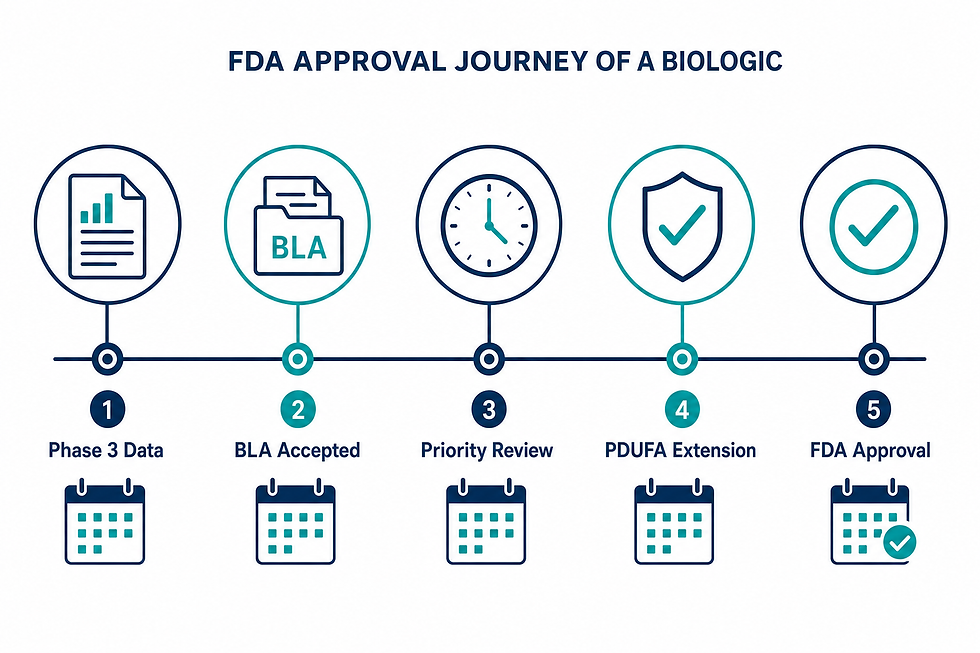
Orca Bio's regulatory history with this product illustrates how long and iterative advanced therapy development can be. The company's Biologics License Application (BLA) for **Orca-T** was accepted by the FDA on **6 October 2025**, with **priority review** designation attached. Positive pivotal Phase 3 results were first announced on **17 March 2025**, with fuller data following on **15 December 2025**. The FDA subsequently extended its review timeline, announcing on **1 April 2026** a new **Prescription Drug User Fee Act (PDUFA)** target action date of **6 July 2026** following a "Major Amendment" relating to updated **chemistry, manufacturing and controls (CMC)** information — notably, without any additional clinical data being requested. The FDA ultimately approved the product ahead of that revised deadline, on 30 June 2026. Understanding how CMC amendments can extend a PDUFA timeline without reopening the clinical case is a core component of the Entry to Regulatory regulatory affairs training programme, which covers BLA lifecycle management and FDA review timeline mechanics as part of its practical curriculum for EU, UK and US regulations — see the full course details at https://pages.entrytoregulatory.com/courses/
What Tregzi Is and How Its Three-Component Design Works
**Tregzi**, marketed under the developmental name **Orca-T**, is an **allogeneic regulatory T cell-based immunotherapy** built from cells sourced from a closely **HLA-matched donor**, typically matched at **8 of 8 HLA loci**. Rather than being a single cellular product, Tregzi is administered as **separate infusion bags** containing three distinct, precisely dosed components:
1. **Haematopoietic stem and progenitor cells (HSPCs)** — responsible for reconstituting the patient's blood and immune system after the pre-transplant conditioning regimen.
2. **Regulatory T cells (Tregs)** — infused ahead of conventional T cells to help establish immune tolerance and suppress the graft-versus-host reaction before it can take hold.
3. **Conventional T cells (Tcons)** — added afterward, in carefully calibrated doses, to help preserve the anti-leukaemic "graft-versus-leukaemia" effect that gives allo-HSCT its curative potential.
Patients must first undergo a **myeloablative preparative regimen** before receiving the sequential infusions. The generic name recorded in FDA documentation — **allogeneic regulatory T cell-based immunotherapy with HSPC and T cells-vldq** — reflects this composite, multi-cell-type structure, which is itself a distinguishing regulatory feature: Tregzi is reviewed and labelled as a single licensed biologic despite comprising several separately manufactured and dosed cellular components.
> "On June 30, 2026, the FDA approved Tregzi, the first regulatory T (Treg) cell-based immunotherapy aimed at improving chronic graft-versus-host disease (GVHD)-free survival in adult blood cancer patients undergoing allogeneic hematopoietic stem cell transplantation."
> — FDA press announcement, 30 June 2026

The Regulatory Pathway: From PRECISION-T to FDA Approval
Tregzi's approval was supported by the pivotal Phase 3 **PRECISION-T trial**, which enrolled **187 participants**. The trial compared Tregzi against conventional, unmanipulated allogeneic grafts and assessed **chronic GvHD-free survival** as its primary measure of benefit. The results, consistently reported across independent sources, were substantial:
Outcome (at 12 months) | Tregzi | Conventional allo-HSCT |
Chronic GvHD-free survival | 78% | 38% (reported as 38.4% by the FDA) |
Moderate-to-severe chronic GvHD incidence | 12.6% | 44.0% |
Overall survival | 94% | 83% |
Independent commentary noted that the **overall survival difference was not statistically significant**, even though the chronic GvHD-free survival benefit was described as statistically significant — an important distinction for regulatory affairs professionals assessing how a label's efficacy claims map onto the underlying statistical analysis plan. Tregzi's development benefited from both **Orphan Drug designation** and **Regenerative Medicine Advanced Therapy (RMAT) designation**, the latter being an FDA programme intended to expedite development and review of regenerative medicine products that address unmet medical needs for serious conditions.
Regulatory professionals looking to deepen their understanding of Biologics License Application (BLA) submissions for advanced cell and gene therapy products will find relevant practical training in the Entry to Regulatory course, which includes hands-on assignments covering FDA regenerative medicine pathways, RMAT designation strategy and orphan drug application requirements as part of its US regulatory curriculum. Full details at https://pages.entrytoregulatory.com/courses/
It is also worth flagging for accuracy that the FDA's own press release recorded the control arm's chronic GvHD-free survival rate as **38.4%**, while several secondary industry sources rounded this to **38%**. Readers relying on this figure for submission-critical work should verify the precise value directly against the FDA's approved labelling and the published PRECISION-T trial data once available.
Safety Profile and Post-Marketing Considerations
As with other advanced cell therapies involving donor-derived immune cells, Tregzi's safety profile requires structured monitoring throughout the transplant and recovery period. Adverse events reported consistently across FDA and industry sources include:
1. **Mucositis** — reported as a common adverse reaction, consistent with the intensive conditioning regimen required before infusion.
2. **Diarrhoea** — reported among common gastrointestinal adverse effects.
3. **Infections** — reported as an expected transplant-related complication, though at a **lower incidence** than seen with conventional allo-HSCT in the PRECISION-T comparator arm.
4. **Graft failure and GvHD** — both flagged in prescribing information as risks requiring ongoing monitoring, despite the therapy's design intent to reduce chronic GvHD specifically.
Notably, the FDA's press announcement specified that Tregzi's safety profile in PRECISION-T showed **no severe infusion reactions and no cases of graft failure**, a reassuring signal given the multi-component infusion process. Regulatory affairs and pharmacovigilance teams working on similarly structured multi-component cell therapies should expect post-marketing surveillance to focus heavily on the sequencing and timing of the three infused cell populations, since dosing errors or sequencing deviations represent a distinct risk category for this product class compared with single-component biologics.
Market and Access Context
Following approval, **Orca Biosystems, Inc.** confirmed plans to launch Tregzi initially at **selected transplant centres**, alongside work on reimbursement pathways appropriate for a high-cost, personalised cellular therapy. Industry reporting from *Fierce Pharma* cited a treatment cost of approximately **$428,000**, alongside comments from **Nate Fernhoff**, described in that reporting as Orca Bio's chief executive, regarding potential future capital markets activity. As this pricing figure and the executive commentary were reported by a single outlet in the research reviewed for this article, they should be treated as **currently unverified against a second independent source** and confirmed directly with Orca Bio's own investor communications before being relied upon in any commercial analysis.
For regulatory affairs professionals, the market access dimension of this approval is a useful case study in how a **RMAT-designated**, **orphan drug**-designated cellular therapy moves from a narrow, hospital-based launch toward broader adoption — a pattern increasingly common across the advanced therapy medicinal product landscape in both the US and, with different designations, the EU and UK.
Deepen Your Knowledge: Regulatory Affairs Training on This Topic
Approvals like Tregzi's demonstrate several regulatory affairs competencies with direct relevance to the growing advanced therapy and cell and gene therapy sector: understanding how the FDA evaluates a **multi-component biologic** as a single licensed product, how **RMAT** and **Orphan Drug** designations interact with standard BLA review timelines, and how a **CMC-driven Major Amendment** can extend a PDUFA date without reopening clinical review.
The Entry to Regulatory course curriculum addresses these areas directly, with modules covering **US FDA biologics and regenerative medicine approval pathways**, **CMC regulatory affairs for complex biologics**, and **clinical trial data interpretation for regulatory submissions**, alongside comparative coverage of how equivalent advanced therapy products are regulated under the **EU (EMA)** framework for **Advanced Therapy Medicinal Products (ATMPs)** and the **UK (MHRA)** equivalent. This comparative grounding is particularly valuable given how differently the US, EU and UK frameworks classify and review cell-based therapies.
This training is most valuable for **life science graduates** aiming for their first regulatory affairs role in the cell and gene therapy sector, **scientists and clinical researchers** transitioning from bench or trial work into submission-facing regulatory roles, and **pharmacy professionals** seeking to specialise in advanced therapies — all of whom benefit from structured exposure to how a real, complex multi-component approval like Tregzi's actually moves through the regulatory system.
TRAINING SPOTLIGHT BOX: **Course:** Introduction to Regulatory Affairs **Provider:** Entry to Regulatory **Relevant to this topic:** FDA Biologics License Application (BLA) process for advanced therapies, Regenerative Medicine Advanced Therapy (RMAT) and Orphan Drug designation strategy, CMC regulatory affairs for multi-component biologics, Phase 3 clinical trial data interpretation, comparative EU (ATMP)/UK/US advanced therapy regulation **Format:** Online, part-time | 6 hours per week | 3 months **Includes:** Up to 3 months real work experience, job mentoring, CV review, mock interviews, industry-recognised certificate **Suitable for:** Life science graduates, pharmacy professionals, career changers, scientists seeking regulatory transition **Start here:** https://pages.entrytoregulatory.com/courses/
Practical Implications for Regulatory Affairs Professionals
Sponsors, transplant centres and regulatory affairs teams tracking advanced cell therapy approvals will have specific questions about how Tregzi's approval affects their own development, submission or care-pathway planning. The table below addresses the most relevant of these.
Key Question | Previous Situation | What Changes Now |
Was there an FDA-approved therapy specifically for chronic GvHD prevention after allo-HSCT? | No approved product existed with dedicated regulatory approval for chronic GvHD-free survival as a primary endpoint. | Tregzi is now the first approved regulatory T cell-based immunotherapy with this specific labelled benefit. |
How is a multi-component cell therapy like this regulated as a single product? | Regulatory precedent for reviewing sequentially infused, separately manufactured cell populations as one licensed biologic was limited. | Tregzi's approval provides a concrete precedent for how the FDA reviews and labels a three-component cellular product (HSPCs, Tregs, Tcons) under a single BLA. |
Can a CMC amendment delay a PDUFA date without triggering a full clinical data request? | Sponsors often assumed Major Amendments risked reopening clinical review entirely. | Orca Bio's experience confirms that a CMC-focused Major Amendment can extend the PDUFA date by a defined period without additional clinical data being requested. |
What designations supported this development timeline? | Standard BLA timelines applied to comparable advanced cell therapies without expedited designations. | Tregzi's combination of RMAT and Orphan Drug designation offers a benchmark for sponsors assessing whether their own advanced therapy candidate may qualify for similar expedited pathways. |
How should reimbursement and access planning begin for a high-cost personalised cell therapy? | Limited precedent existed for reimbursement strategy specific to multi-component, donor-matched cellular products at this price point. | Orca Bio's phased, selected-centre launch model offers an early template, though pricing details reported to date remain only single-source verified. |
Does the overall survival data need separate regulatory scrutiny from the chronic GvHD-free survival claim? | N/A — no precedent product existed. | Yes: the label's primary claim rests on statistically significant chronic GvHD-free survival, while the overall survival difference (94% vs 83%) was not statistically significant — a distinction regulatory and medical affairs teams must communicate precisely. |
Will full peer-reviewed PRECISION-T data be available to support HTA and payer submissions? | N/A | At the time of approval, full peer-reviewed publication details beyond the December 2025 data announcement were not independently confirmed; market access teams should track for formal publication. |
Key Takeaways
1. **Map your own multi-component product's regulatory strategy** against Tregzi's precedent if you are developing a cellular therapy with sequentially infused components under a single BLA.
2. **Review CMC change-control processes** now, given that a Major Amendment on chemistry, manufacturing and controls information extended Orca Bio's PDUFA date without a fresh clinical data request.
3. **Distinguish primary and secondary endpoint statistical significance** clearly in any medical affairs or promotional materials referencing Tregzi's chronic GvHD-free survival versus overall survival data.
4. **Track RMAT and Orphan Drug designation criteria** if your own advanced therapy candidate targets a similarly underserved transplant-related complication.
5. **Verify the reported $428,000 treatment cost and executive commentary** against Orca Bio's own investor communications before citing these figures in any commercial or competitive analysis.
6. **Monitor for full peer-reviewed PRECISION-T publication** to support downstream health technology assessment (HTA) and payer dossier preparation.
7. **Benchmark transplant centre launch sequencing** if you are planning market access for a comparably priced, hospital-administered cell therapy.
Take the Next Step in Your Regulatory Affairs Career
Tregzi's approval is a clear illustration of where regulatory affairs expertise is most needed today: advanced, multi-component biologics that do not fit neatly into traditional small-molecule or single-cell-type regulatory frameworks. Understanding how the FDA (and, under different frameworks, the EMA and MHRA) evaluates products like this is a core skill for regulatory affairs professionals at every career stage, from those entering the field to those specialising in cell and gene therapy.
If topics like RMAT designation, CMC lifecycle management and BLA strategy for advanced therapies interest you, the Introduction to Regulatory Affairs course at Entry to Regulatory is a practical next step. A free introductory webinar is available if you would like to explore the course with no commitment.
Explore the full course details and register for a free introductory webinar at Entry to Regulatory: https://pages.entrytoregulatory.com/courses/

Frequently Asked Questions
### What is Tregzi (Orca-T) approved to treat?
Tregzi is approved by the FDA to improve **chronic graft-versus-host disease (cGvHD)-free survival** in adults undergoing **matched donor allogeneic haematopoietic stem cell transplantation** for haematological malignancies, following a myeloablative preparative regimen.
### How is Tregzi different from a standard stem cell transplant?
Tregzi adds two additional, precisely dosed and sequentially infused cell populations — **regulatory T cells** and **conventional T cells** — alongside the haematopoietic stem and progenitor cells used in a conventional transplant, specifically designed to reduce chronic GvHD while preserving the graft-versus-leukaemia effect.
### What clinical evidence supported the FDA approval?
Approval was based on the Phase 3 **PRECISION-T trial** of 187 participants, which showed a **78% one-year chronic GvHD-free survival rate** for Tregzi compared with **38.4% for conventional transplants**, alongside lower rates of moderate-to-severe chronic GvHD.
### When exactly was Tregzi approved by the FDA?
The FDA approved Tregzi on **30 June 2026**, as confirmed in the FDA's official press announcement and drug approval resources.
### How can I build the regulatory affairs skills needed to work on approvals like this?
Understanding how a complex, multi-component cell therapy like Tregzi moves from Phase 3 data through FDA review to an approved label is exactly the kind of skill covered in the Introduction to Regulatory Affairs course at Entry to Regulatory, which includes modules on advanced therapy regulation across the US, EU and UK alongside practical work experience and job search mentoring — see https://pages.entrytoregulatory.com/courses/
Next cohort starts: 13 August 2026. Limited spaces available.
Further Reading and Reference Sources
1. **FDA Approves New Treatment That Uses Donor Immune Cells to Prevent Serious Complications of Blood Cancer Treatment — U.S. Food and Drug Administration** (https://www.fda.gov/news-events/press-announcements/fda-approves-new-treatment-uses-donor-immune-cells-prevent-serious-complications-blood-cancer) — Published: 30 June 2026
2. **FDA Approves Allogeneic Regulatory T Cell-Based Immunotherapy (HSPC and T Cells-vldq) for Use in Matched Donor Transplantation — U.S. Food and Drug Administration** (https://www.fda.gov/drugs/resources-information-approved-drugs/fda-approves-allogeneic-regulatory-t-cell-based-immunotherapy-hspc-and-t-cells-vldq-use-matched) — Published: 30 June 2026
3. **Orca Bio's TREGZI Receives U.S. FDA Approval as First and Only Precision-Engineered Cell Therapy for Allogeneic Transplant in Adults with Hematological Malignancies — Orca Bio** (https://orcabio.com/orca-bios-tregzi-receives-u-s-fda-approval-as-first-and-only-precision-engineered-cell-therapy-for-allogeneic-transplant-in-adults-with-hematological-malignanciesorca-bio-adds-east/) — Published: 30 June 2026
4. **TREGZI Prescribing Information — Orca Bio** (https://orcabio.com/TREGZI-pi)
5. **Orca Bio Announces FDA Review Extension of BLA for Orca-T for the Treatment of Hematologic Malignancies — Orca Bio** (https://orcabio.com/orca-bio-announces-fda-review-extension-of-bla-for-orca-t-for-the-treatment-of-hematologic-malignancies/) — Published: 1 April 2026
6. **Orca Bio Takes Commercial Leap with FDA Approval for Tregzi — Fierce Pharma** (https://www.fiercepharma.com/pharma/fda-approves-orca-bio-cell-therapy-tregzi-blood-cancer-transplants)
7. **FDA Approves Tregzi for Matched Donor HSCT in Hematologic Malignancies — CGTLive** (https://www.cgtlive.com/view/fda-approves-tregzi-matched-donor-hsct-hematologic-malignancies)
8. **Orca-T Gains FDA Approval for Matched Donor Stem Cell Transplant — AJMC** (https://www.ajmc.com/view/orca-t-gains-fda-approval-for-matched-donor-stem-cell-transplant)
9. **FDA Extends Review Timeline of Orca-T for MDS, Leukemia — Targeted Oncology** (https://www.targetedonc.com/view/fda-extends-review-deadline-of-orca-t-for-mds-leukemia)
About the Author: Rabiea is an Honorary Associate Professor at UCL, former MHRA Health Authority reviewer, and CEO of Entry to Regulatory and Advanced Regulatory Consulting. After transitioning from retail pharmacy to regulatory affairs, she has dedicated her career to helping others make the same successful career change. Connect with her on LinkedIn for the latest regulatory affairs insights and career advice.
Disclaimer
This article is provided for informational purposes only. Regulatory guidance, legislative instruments and health authority policies evolve frequently. Always consult the most current official publications from the relevant health authority — including the MHRA, UK Space Agency and Civil Aviation Authority — and seek qualified professional regulatory advice for specific product development, submission or compliance decisions. Entry to Regulatory training courses are designed for educational and career development purposes.

Mình đọc mấy bài kiểu này được một thời gian, coi như nguồn tham khảo thôi chứ không đặt niềm tin tuyệt đối. Hồi trước mình hay chọn đại theo cảm giác, thấy con nào nhìn “ưng mắt” là xuống tiền, trượt thì lại ngồi tiếc. Dạo gần đây mình tập ghi chép lại kết quả từng lần, rồi tự xem lại nhịp ra số nên tâm lý ổn hơn, đỡ bị ảnh hưởng bởi lời truyền miệng. Có lúc mình thử soi cau mb theo dàn với lô rơi, thỉnh thoảng trùng hợp nghe cũng vui, nhưng nhiều hôm lệch hẳn nên mình xem đó như cách rèn kỷ luật và kiểm soát vốn. Quan trọng là tự đặt…